
From zero to production with obskitpy: a sales ETL, reviewed as a demanding senior developer and a demanding QA
This is a dogfooding report. I built a small ETL (exemplo-etl-vendas/: extract a dirty CSV export, clean and validate it, load a warehouse) and took it from an empty folder to DEV, HMG and PRD using only obskitpy 1.0.0, built as a wheel and installed in a clean virtualenv. Every friction point is written down, whether it is a bug, a missing feature or a rough edge.
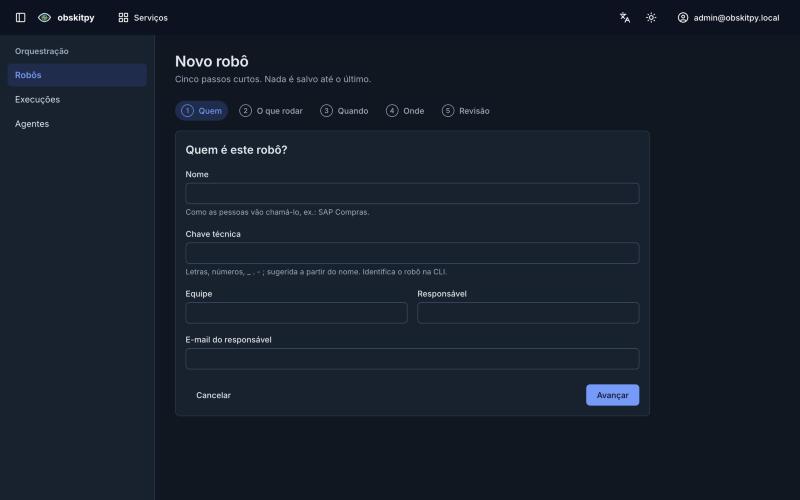
What was tested: a real Docker stack, a real portal on PostgreSQL, a real agent executing the ETL as a child process, real telemetry in Elasticsearch. What was not tested: GitHub (OAuth, webhook, pull request), Azure, Slack/Telegram alerts, the pipeline builder (they need accounts and are covered by earlier tests against fakes), the Angular wizard end to end (only step 1 was captured here; the robot was registered with the CLI).
1. The project
| Piece | What it does |
|---|---|
etl/extract.py |
reads the CSV, no cleaning, span extract |
etl/transform.py |
amounts in three formats, two date formats, currency conversion, status check, de-duplication; every rejected row returns with its reason; span transform |
etl/load.py |
one transaction, INSERT OR REPLACE, so a re-run (retry) leaves the same rows; span load |
etl/pipeline.py |
counters etl.rows.extracted/loaded/rejected, a quality gate (more than 15% rejected fails the run before loading anything) |
tests/ |
13 tests (formats, rejects, idempotent load, gate) |
data/orders.csv |
1,012 deterministic rows with 6.6% real-world dirt and 12 re-sent orders |
2. The journey
| Step | Command or action | Result |
|---|---|---|
| Install | uv venv --python 3.12, uv pip install obskitpy-1.0.0.whl[portal] |
OK (see gap G1) |
| Stack | obskitpy init -y --standalone --service etl-vendas --local both --up |
Elasticsearch, Collector, Kibana and the console up in 63 s |
| Portal | obskitpy portal enable |
up after fixing G2; admin password printed once |
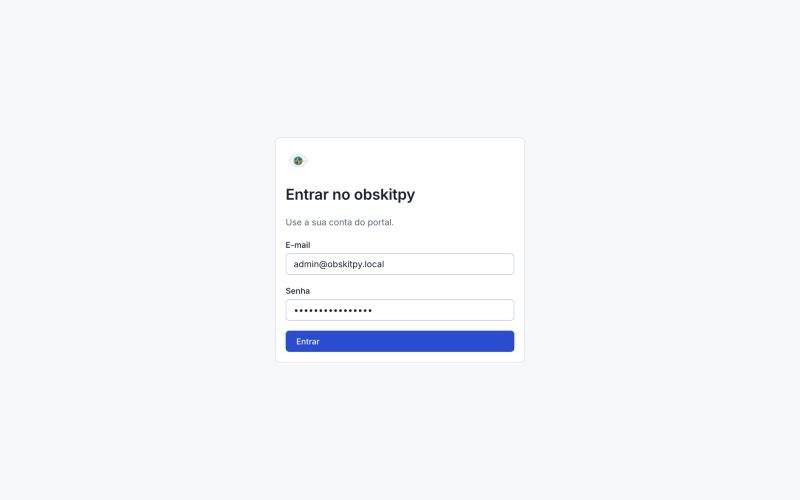
| Sign in | console login, obskitpy login |
OK |
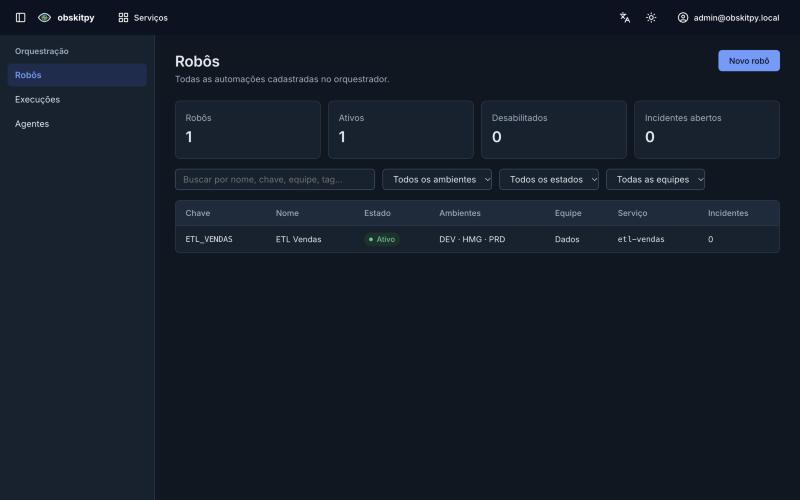
| Register | obskitpy robot create --key ETL_VENDAS --env dev hmg prd ... |
robot visible in the console |
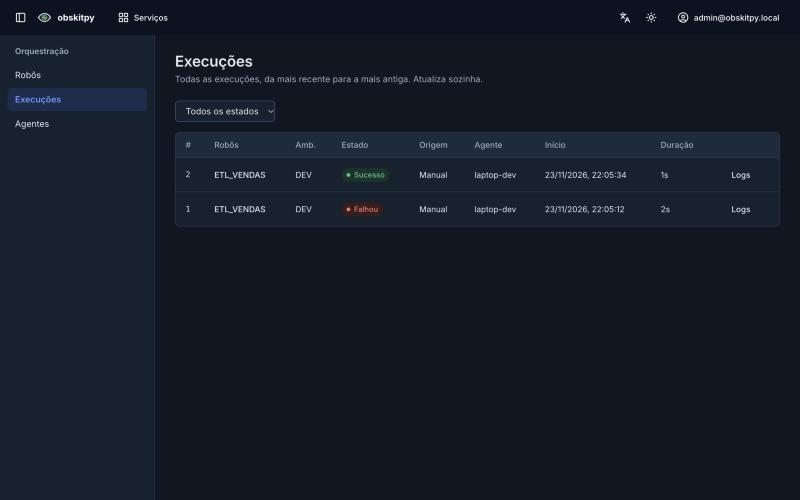
| Run in DEV | obskitpy agent run, obskitpy robot run ETL_VENDAS --env dev --follow |
logs streamed live, SUCCEEDED: 1,012 extracted, 945 loaded, 67 rejected |
| Observe | console, Observability | traces etl-run, transform, extract, load, logs, p95 |
| Release | console, robot page, "Nova release" 1.0.0 | recorded |
| Deploy | DEV and HMG immediate, PRD "aguardando aprovação", approved in Approvals | works |
| Run HMG and PRD | robot run --env hmg, --env prd |
SUCCEEDED, one warehouse file per environment |
| Fail on purpose | HMG source with half the amounts broken, retry_max=1 |
gate failed 538 of 1,012 (53%), retry ran, warehouse kept its 945 rows |
| Schedule | API: DEV every 5 minutes, PRD daily | created (no CLI, see G9) |
Screenshots
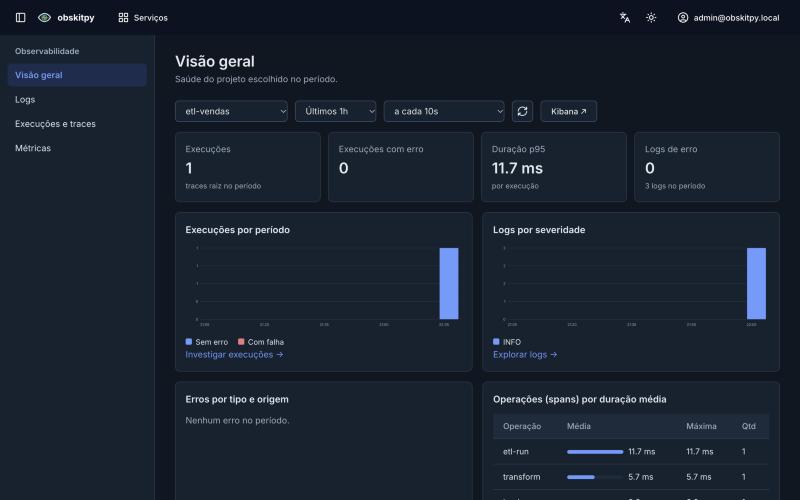
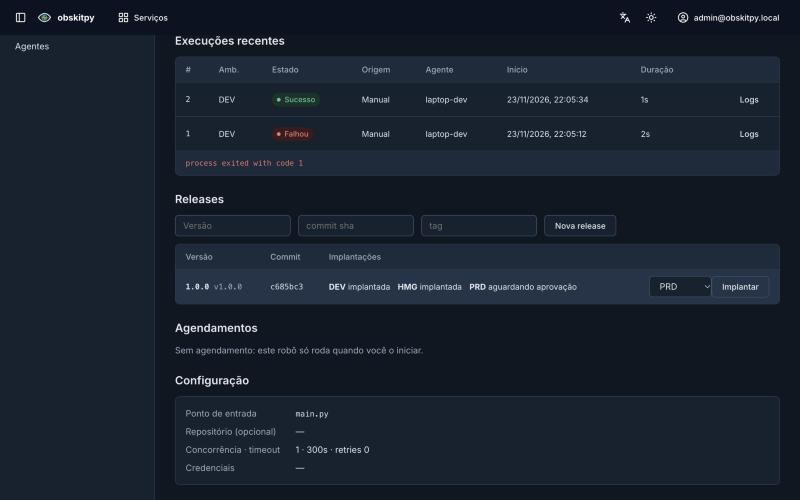
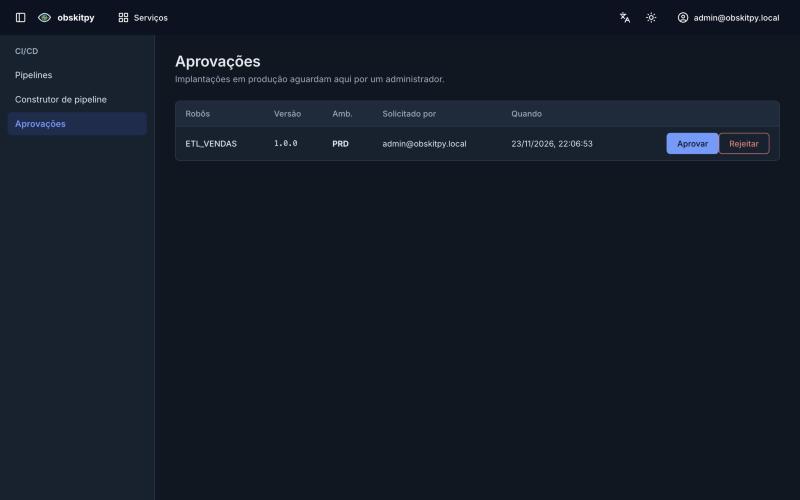
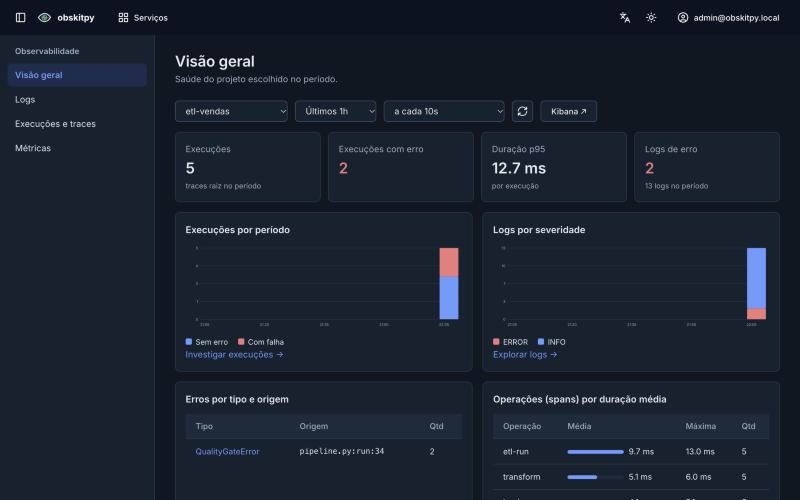
3. Verdict
Senior developer: the happy path is good. Registering a robot is one command, running it and following its logs is one more, and telemetry shows up without extra wiring (obskitpy.setup(...) plus traced). The error view grouping by type and origin (QualityGateError, pipeline.py:34) is exactly what you want at 3 a.m. What I did not trust: environments are not isolated (G4, G5), and a release cannot be registered from CI (G8).
QA: failure handling behaved: the gate stopped a bad load, the retry was scheduled with the configured backoff, the previous good data stayed. What I would block a release for: G3, G4, G5 and G6.
4. Gaps, by priority
Update: the four blockers (G3 to G6) were fixed after this report: agents declare the environments they serve (obskitpy agent run --env dev hmg, default dev, migration 0008), PRD approval needs a second administrator (or OBSKITPY_ALLOW_SELF_APPROVAL=1 for one-person teams) and asks for confirmation and a note, the observability pages have an environment selector (?env=hmg deep link), and the supported Python range is 3.10 to 3.13 with a doctor check. Covered by tests; the environment filter was also checked in the console against this run's data.
Blockers for production use
| # | Gap | Evidence | Suggested fix |
|---|---|---|---|
| G4 | Agents are not scoped by environment. An agent started with --label env=dev executed HMG and PRD runs. A laptop can write to production. |
runs 3 and 4 in runs list |
agent --env dev,hmg (allow list), refuse to claim runs of other environments |
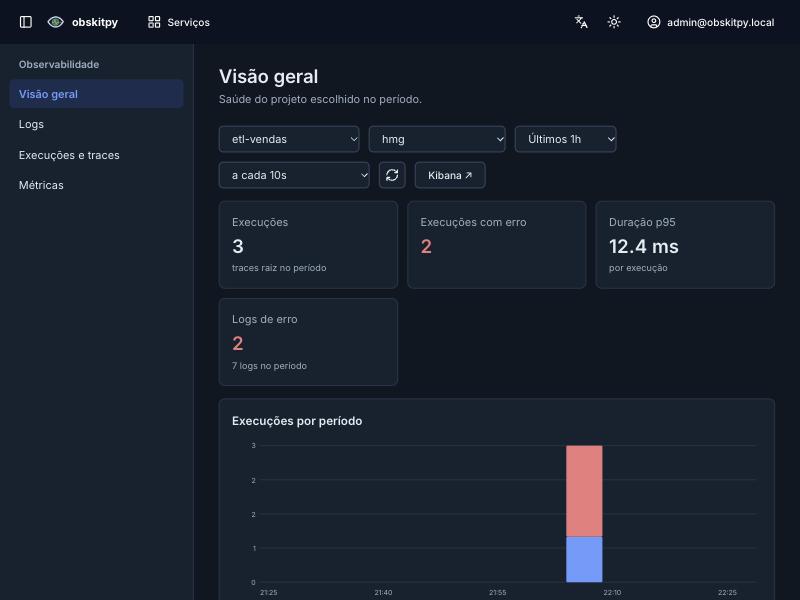
| G5 | Observability mixes environments. The overview shows dev, hmg and prd traces of one service together; the failures of HMG look like failures of "etl-vendas". | screenshot 8 | an environment selector on every observability page (the data already carries the environment resource attribute) |
| G6 | The same admin can request and approve a PRD deployment, with no confirmation dialog and no note. | screenshot 7 | four-eyes rule (approver differs from requester, configurable), confirm dialog, note field |
| G3 | Python 3.14 crashes at import obskitpy (OTLP/protobuf: "Metaclasses with custom tp_new are not supported"). Installation succeeds, the robot dies at startup, and obskitpy doctor does not warn. |
run 1 | cap requires-python or the protobuf pin, add the check to doctor |
Important
| # | Gap | Suggested fix |
|---|---|---|
| G1 | Portal commands need the [portal] extra; the error does not say it. |
message that names the extra |
| G2 | The portal container installs obskitpy==VERSION from PyPI, so any unpublished build crash-loops. --pip-spec solves it but is not in the guide, and a plain portal enable re-run overwrites a hand edit of OBSKITPY_PIP_SPEC. |
document --pip-spec; keep a manual edit |
| G7 | Only one stored login (~/.config/obskitpy/credentials.json): logging in to this portal replaced the token of another portal. |
named profiles, --profile |
| G8 | No CLI for releases, deployments or approvals. A CI job cannot register a release, and the console asks for the commit SHA and tag by hand. | obskitpy release create --version --sha, deploy, approve |
| G9 | No CLI for schedules (API only). Cron is UTC only (the console labels it, but there is no timezone setting): 0 6 * * * is 03:00 in Brazil. |
obskitpy schedule add/list, timezone per schedule |
| G10 | The agent does not install the robot's dependencies, so the venv of the agent must already have them. | per-robot virtualenv from requirements.txt |
| G11 | A deployment only records a version. Nothing changes where the code runs. The robot runs whatever is in the agent's source folder. | the agent should check out the released SHA |
Polish
| # | Gap |
|---|---|
| G12 (fixed) | CLI text still in Portuguese: Derrubando a stack, Stack derrubada, Arquivos, Esperando o Kibana ficar pronto, Kibana pronto, Aplicando o dashboard, Dashboard aplicado, dashboard no Kibana, ao encerrar, status help. |
| G13 (fixed) | robot run --follow prints the success symbol twice (✔ ✔ SUCCEEDED). |
| G14 (fixed) | runs list shows UTC, the console shows local time. |
G15 (fixed: runs ignore) |
The first failed run (G3) stays in the history of DEV with the failure rate; there is no way to mark a run as "ignored". |
| G16 (fixed) | robot get is JSON only and robot get --json is rejected: inconsistent with other commands. |
Not exercised
Alerts and incidents (they need Slack or Telegram), GitHub connection and the pipeline builder, Azure, the full wizard path in the browser, load of the ETL itself.
5. What worked better than expected
- The quality gate plus the idempotent load made the retry safe without any orchestrator feature.
- Rejected rows carry their reason into the
rejected_orderstable: the QA question "what did you throw away and why" has an answer. - The run environment carries
OBSKITPY_ENV,OBSKITPY_RELEASEand the OTLP endpoint, soetl/config.pyneeded nothing butos.environ(the version tag in the telemetry was not checked in this pass).